Biography
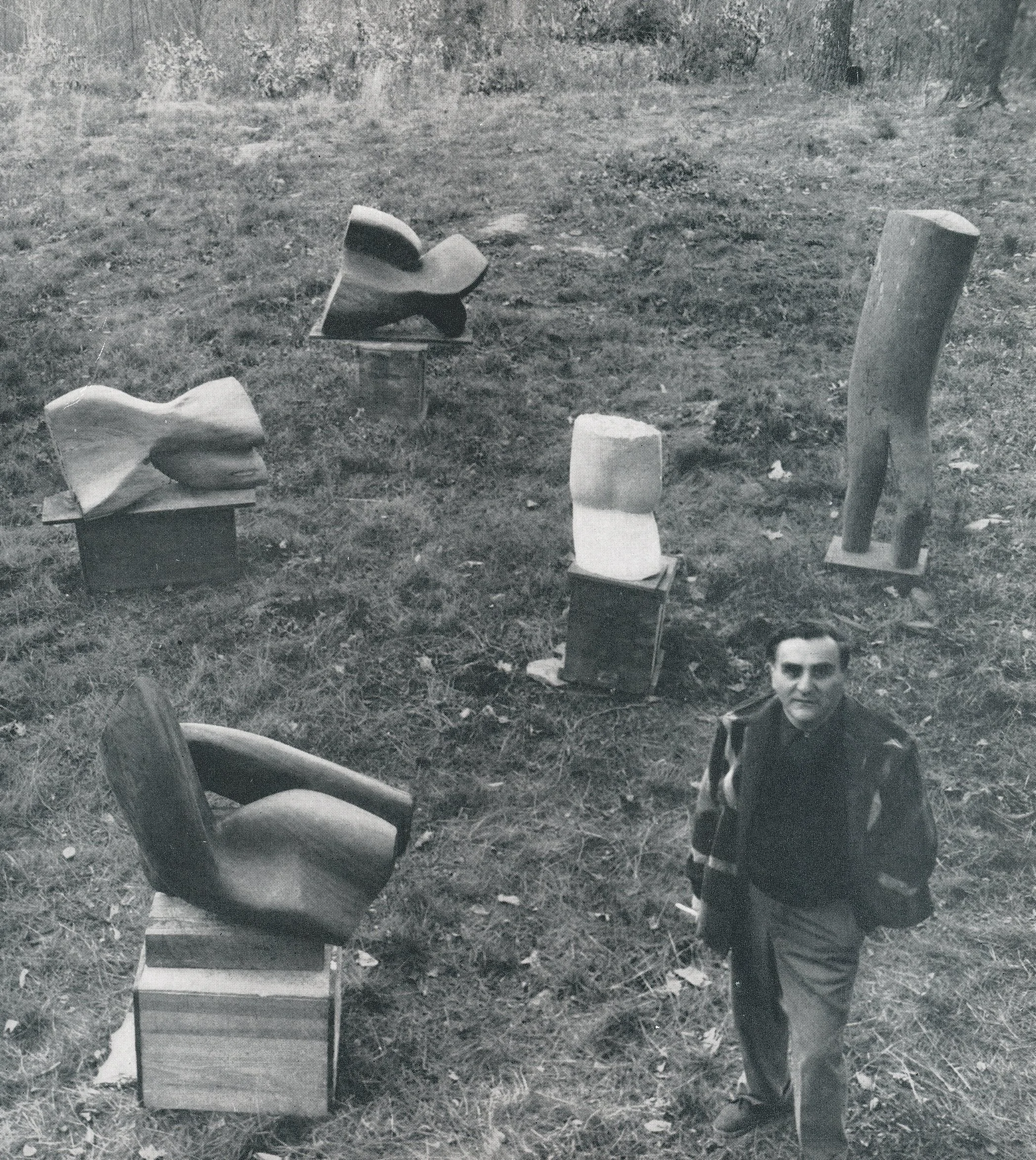
“You stare at the wood and finally have to do something. You make a cut. From then on it follows. Like the jazz musician, music comes out of you.”
Born Haig Heukelekain in Constantinople in 1905 in an Armenian family, he lived in the capital city of Turkey (now known as Istanbul). In 1921, his family moved to Egypt, but Haig emigrated to United States, traveling through Marseille, Paris, Le Havre and New York, joining his older brother at Ames College in Iowa. After a year, he left school and made his way to Chicago where he became friends with art students at the School of the Art Institute of Chicago. He supported himself with a variety of odd jobs including work as an usher at the Opera House which he loved, apparently, for the proximity it offered to the fantastically costumed divas. It was his tango partner Maria, with whom he traveled the local vaudeville circuit, who encouraged him to change his name to Raoul Hague.
In 1925, Hague moved to New York City and began attending the Art Students League where he was a monitor for the sculptor William Zorach’s class. It was around this time that he also befriended John Flanagan and Arshile Gorky. A shared experience of Armenian descent and love of art was the foundation of Hague’s friendship with Gorky. In addition to Gorky, Hague became acquainted with Stuart Davis, Reuben Nakian, and Willem de Kooning during the late ‘20s through the ‘30s.
In 1930, he became a U.S. citizen. In 1933, Hague exhibited two stone sculptures in “American Sources of Modern Art,” at the Museum of Modern Art. It would be decades before the artist showed as many works in New York again. From 1935 to 1939, Hague served on the Federal Arts Project of the WPA. Much of his stone sculpture work from this period has been lost.
It was through his friendship with the American novelist, poet, and utopian Hervey White, that Hague began occasional visits to Woodstock. White had founded the Maverick Art Colony in 1905. When White died in 1944, Hague purchased his property from the estate and decamped to Woodstock permanently.
In Woodstock, Hague lived and worked in White’s historic Maverick cabin and studio. He embraced direct carving and truth to materials. During this time, Hague transitioned to working strictly in wood stating that “finding of a stump or fallen log releases the initial [sculptural] idea.” Often, his finished sculpture became titled for the sites and the original blocks “which fathered the thoughts.”(1) to accommodate his human-scaled sculptures fashioned from single logs and tree trunks. Hague privileged studio time over career mindedness, and only participated in a handful of exhibitions in his lifetime with Curt Valentin’s Buchholz Gallery, Charles Egan Gallery, Xavier Fourcade, and Lennon Weinberg.
Hague’s sculptures are characterized by their undulating surfaces and supple curves carved in concert with the natural grain of the wood. The works defy quick reading and carry with them the ambiguous and sublime beauty of the natural world. Hague’s sculptures are timeless examples of Modernist simplicity and the fruits of a lifetime’s devotion to a singular medium.
Hague’s work can be found in the collections of the Albright-Knox Art Gallery, the Art Institute of Chicago, the Metropolitan Museum of Art, the Museum of Modern Art, the San Francisco Museum of Modern Art, and the Whitney Museum of American Art.
_____
1. Sandler, Irving. “Hague: The Wood of Dreams,” Art News, vol. 61 (November 1962), p. 276.